Evolution


  1. Mammals evolved from reptiles about 200-250 mya (in the Mesozoic era)
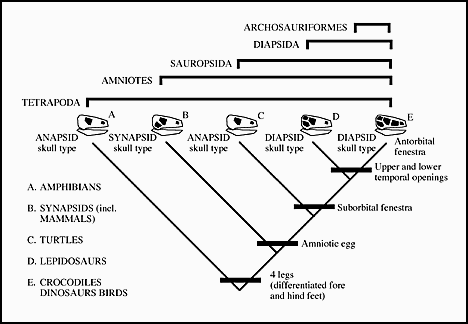
  1. Mammalian ancestors are referred to as mammal-like reptiles (subclass Synapsida, order Therapsida)
  1. Characteristics of synapsids (Subclass Synapsida)

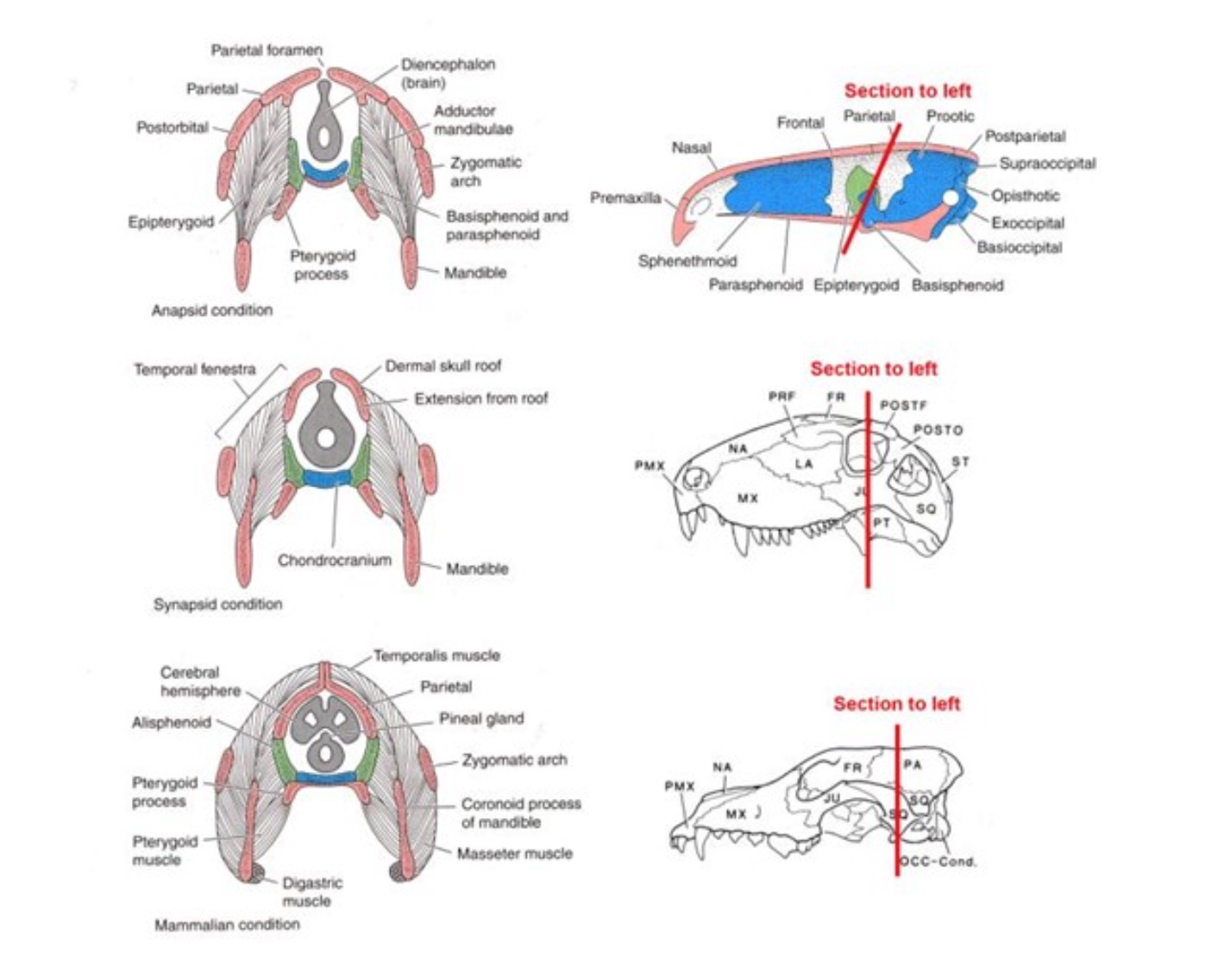
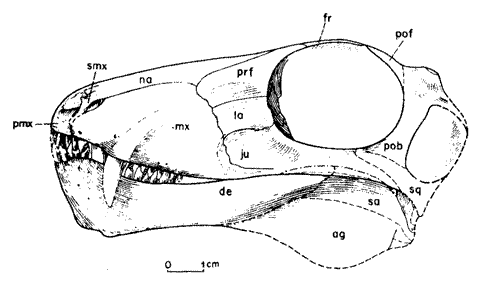
    1. Opening in cranium behind eye (Fig. 4.1)

      1. Contrasts with the solid "temporal shield" (turtles) or multiple temporal openings (snakes, lizards) of other reptiles
      2. Function

        1. May make room for more powerful jaw muscles (Fig. 4.13)
        2. May make skull lighter (without sacrificing strength)
  1. Characteristics of therapsids (Order Therapsida)

    1. Expansion of the dentary bone to make mammalian articulation w/cranium (presence of dentary-squamosal joint is dividing line between reptiles and mammals)(Fig. 4.4)
    2. Attachment of jaw muscles to zygomatic arch
    3. Heterodont dentition
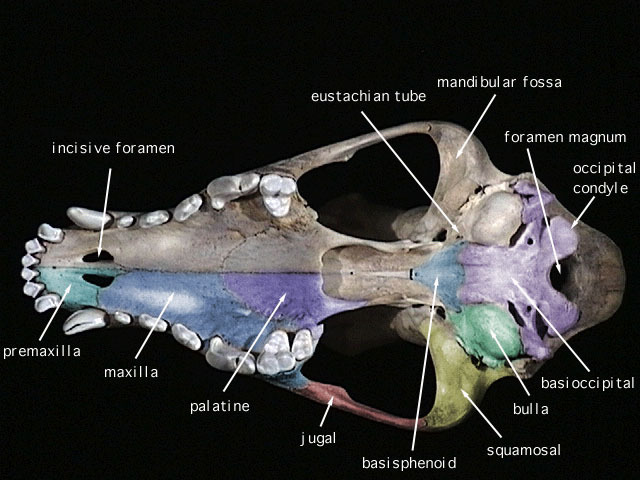
    4. Beginnings of a secondary palate
    5. Less spraddle-legged than ancestors (e.g., Dimetrodon)
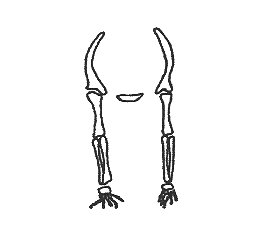
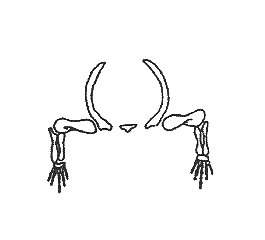
Mammal-like forelimbs Reptilian forelimbs
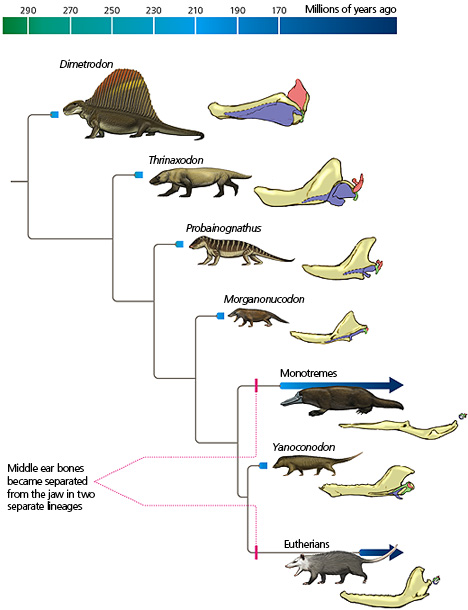
  1. The transition from mammal-like reptiles to mammals (Fig. 4.5)
Reptiles Mammal-like reptiles Mammals
Mandible composed of many bones, including the dentary Increase in size of dentary bone, decrease in size of postdentary bones Mandible composed of a single bone, the dentary
Articulation of mandible with cranium occurs between the articular bone (lower jaw) and the quadrate bone (cranium) Articulation varies, and sometimes occurs in two places Articulation of mandible with cranium occurs between the dentary bone and the squamosal
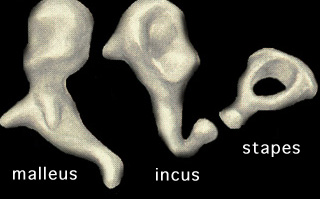
Sound is conducted from the tympanic membrane to the inner ear via a single bone, the stapes Sound is conducted via the stapes, but the articular and quadrate bones also play a role in transmitting sound Sound is conducted from the tympanic membrane by a series of three bones: the malleus (formerly the articular bone), the incus (formerly the quadrate) and the stapes. They are collectively known as the ossicles.
Dentition is homodont Dentition is heterodont Dentition is heterodont
  1. Characteristics of the first mammals

    1. Mouse-sized (new fossils...)
    2. Insectivorous
    3. Probably nocturnal (hiding from dinosaurs)
    4. Relied on well-developed senses of smell and hearing
    5. Probably were homeothermic and had fur as insulation
    6. Probably laid eggs
    7. Probably had mammary glands
  1. Why did mammals survive, while synapsids went extinct?


  1. Adaptive radiations and waves of extinctions
    1. Breakup of Pangaea and continental drift (Fig. 4.11)(200-65 mya)
    2. Extinction of dinosaurs (65 mya)
    3. Modern species are ca. 2 my old