|
|
| Arthur
N. Popper
Professor,
Department
of Biology
Co-Director,
Center
for Comparative and Evolutionary Biology of Hearing
Associate Dean,
College of Chemical and Life Sciences Department of Biology
The University of Maryland
College Park, MD 20742
Phone: (301)
405-1940
E-mail: apopper@umd.edu
Curriculum
Vitae |

|
|
| Education |
| Ph.D. |
1969 |
Biology,
City University of New York |
| B.A. |
1964 |
Biology, New
York University, Bronx, NY |
|
|
|
Research Interests |
|
The work in my
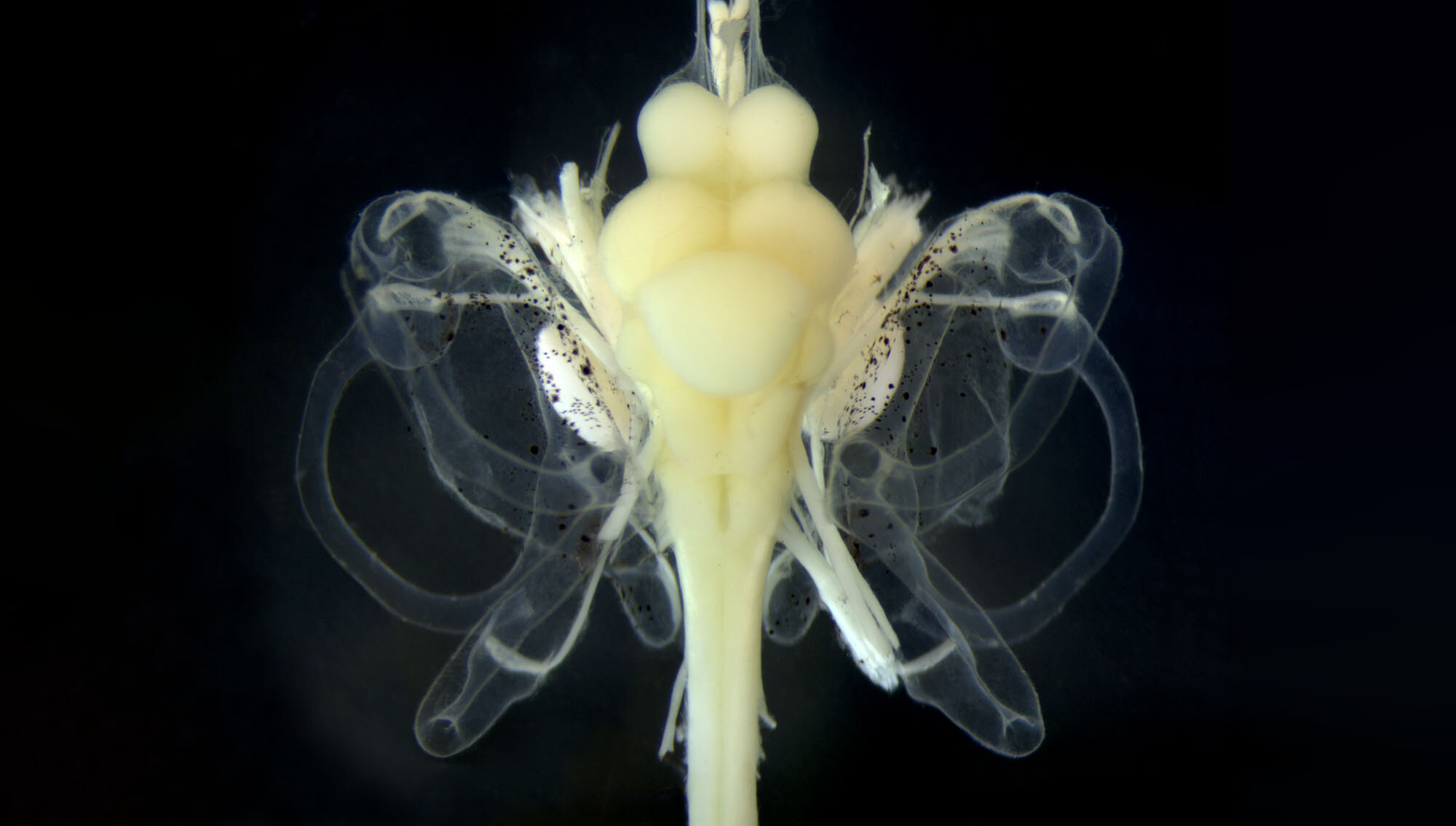
laboratory was, for many years, directed towards understanding basic structure
and function of the auditory system in vertebrates, with particular
interest in the ear of fishes and its sensory hair cells.
These investigations frequently involved a wide number of teleost
species (e.g., goldfish, zebrafish, cichlids, American
shad, sleeper gobies) and the use of the comparative approach
in order to understand the function of the ear as well as
its evolution. More recently, the focus of our work has
become redirected to apply our expertise on fish
bioacoustics to more applied questions that examine the
effects of human-generated (anthropogenic) sound on fish.
Past work
Using a variety
of different behavioral paradigms, we have determined the
range of sounds fish can hear, as well as their ability to
discriminate signals. Most recently, we have discovered that
the American shad is able to detect ultrasound (up to 180
kHz), in contrast with most other species of fish that can
detect sounds to only 1 - 3 kHz. The implications of this
finding are considerable, and there are interesting parallels
in this system to the system that has evolved in moths to
detect ultrasound produced by bats. Indeed, we have evidence
that American shad have evolved ultrasound detection to avoid
a major predator of theirs, echolocating dolphins!
Other investigations,
using neuroanatomical methods, asked questions
regarding the central projections of the eighth nerve from
individual end organs of the ear to the brain and the organization
of the eighth nerve at the level of the various end organs.
Questions of sensory
hair cell structure and evolution have been a focal point
of much current research. A significant finding, based upon
work using electron microscopy, immunocytochemistry and other
techniques, has been the discovery of multiple types of sensory
hair cells in the ears of fishes. This finding refutes earlier
work that suggested that hair cell heterogeneity only occurs
in amniotes. Importantly, the discovery of multiple types
of hair cells in fishes helps in our understanding of the
way that the fish ear functions and also has implications
for our understanding of when multiple hair cell types evolved
in vertebrates.
Considerable work
has also been directed at questions of hair cell addition,
development, and regeneration. Unlike most other vertebrates,
fishes add very substantial numbers of sensory hair cells
to the ear for many years after hatching. We have also demonstrated
that fish regenerate hair cells. Current investigations are
directed at determining the patterns of hair cell development
in fishes, with particular emphasis on questions relating
to the similarities and differences between embryonic and
post-embryonic hair cell development and between normal development
and regeneration. Related studies are asking questions about
developmental similarities and differences between different
types of sensory hair cells.
Current work
We have
recently developed considerable interest in the applied use
of sound to control movement of fish and on the effects of anthropogenic
(human-generated) sounds on fishes and marine mammals.. There
is a significant problem in areas of hydropower dams, intakes
to power plants, irrigation ditches, and similar places, where
fish can move or be carried into areas of danger. A variety
of different mechanical and behavioral methods have been tried
to protect fish from these dangers, with varying levels of
success. One of the most successful techniques has been the
use of ultrasound to prevent clupeid fishes (herrings and
relatives) from entering power plant intakes. Our interest
is to help extend the use of sound to other species and sites
since sound potentially could be useful over longer distances
than other stimuli.
A bigger issue
concerns the effects of human-generated (anthropogenic)
sound on aquatic life (e.g., Popper 2003; Popper et al.
2004; Hastings and Popper 2005; Popper and Hastings 2009). Over the past decades
there has been a substantial increase in the human-generated
sounds in the marine environment. While there has been great
concern about the effects of such sounds on marine mammals,
far less consideration has been given to the effects of the
same sounds on fishes and invertebrates. Since the ear of
fishes is based upon the same basic principles and same hair
cell system as that of mammals, there is good reason to suspect
that anthropogenic sounds, and particularly loud sounds such
as those produced by large ships, air-guns, and other sources
might impact fish. Impact could include death, damage to sensory
cells, or stress-related changes. Less overt, but equally
significant, impact could result from long-term changes in
behavior that could alter reproductive potential. These impacts
are of great potential importance not only since fish make
up the major component of the vertebrate marine ecosystem,
but also because they are major components in the food chain
of many marine mammals, and humans.
Over the past
several years, we have investigated the effects of a wide range
of sound sources on fish including seismic air-guns (e.g.,
McCauley et al. 2003; Popper et al. 2005; Song et al. 2008),
sonar (Popper et al. 2007), increased background levels (Smith
et al. 2004a, b, 2006; Wysocki et al. 2007; Davidson et al.
2007), and sounds associated with barging of fish (Halvorsen et
al. 2009) (see Publications link to the left to find specific
references),
Current work is
investigating the effects of pile driving on fish (see Hastings
and Popper 2005 for background). This work, which was overviewed
by Halvorsen et al. (2008) is continuing and includes
examination of the effects of actual pile driving sounds on fish
in the laboratory.
|
|
| Selected
Publications - |
|
For journal articles please follow this link
Journal Articles
you can also use Google Scholar search:
http://scholar.google.com/scholar?hl=en&lr=&scoring=r&q=author%3A%22an+popper%22+&as_ylo=1900
Books
Popper, A.N., and
Fay, R.R. (1980). eds. Comparative Studies of Hearing in Vertebrates. Springer-Verlag,
New York
Tavolga, W.N.,
Popper, A.N., and Fay, R.R. (1981). eds. Hearing and Sound Communication in Fishes. Springer-Verlag,
New York
Atema, J., Fay,
R.R., Popper, A.N., Tavolga, W.N. (1988). eds. Sensory Biology of Aquatic Animals. Springer-Verlag,
New York.
Webster, D.B.,
Fay, R.R., and Popper, A.N. eds. (1992). Evolutionary Biology of Hearing, Springer Verlag,
New York.
Fay, R. R., and Popper, A. N., Series Editors,
Springer Handbook of Auditory Research, multi-volume series on
the hearing sciences published by Springer.
- Volume 1: Webster,
D.B., Popper, A.N., and Fay, R. R. eds. (1992).
The Mammalian Auditory Pathways: Neuroanatomy, Springer
Verlag, New York.
- Volume 2: Popper,
A. N., and Fay, R. R. eds. (1992).
The Mammalian Auditory Pathway: Neurophysiology,
Springer Verlag, New York.
- Volume 3: Yost,
W. A., Popper, A. N., and Fay, R. R. eds. (1993).
Human Psychophysics, Springer
Verlag, New York.
- Volume 4: Fay,
R.R. and Popper, A. N. eds. (1994).
Comparative Hearing: Mammals,
Springer Verlag, New York.
- Volume 5: Popper,
A. N. and Fay, R. R. eds. (1995).
Hearing by Bats, Springer-Verlag,
New York.
- Volume 6: Hawkins,
H.L., McMullen, T.A., Popper, A.N. and Fay, R.R. eds. (1996).
Auditory Computation,
Springer-Verlag, New York.
- Volume 7: Van
De Water, T., Popper, A.N., and Fay, R.R. eds. (1996).
Clinical Aspects of the Auditory System, Springer-Verlag,
New York.
- Volume 8: Dallos,
P., Popper, A. N., and Fay, R. R. eds. (1996).
The Cochlea, Springer-Verlag,
New York.
- Volume 9: Rubel,
E. W, Popper, A. N., and Fay, R. R. eds. (1997).
Development of the Auditory System,
Springer-Verlag, New York.
- Volume 10: Hoy,
R. R., Popper, A. N., and Fay,. R. R. eds. (1998).
Comparative Hearing: Insects,
Springer-Verlag, New York.
- Volume 11: Fay,
R. R. and Popper, A. N. eds. (1999).
Comparative Hearing: Fishes and Amphibians.
Springer-Verlag, New York
- Volume 12: Au,
W., Popper, A. N., and Fay, R. R. (Eds). (2000).
Hearing by Whales and Dolphins. Springer-Verlag,
New York.
- Volume 13: Dooling,
R. E., Fay, R. R. and Popper, A. N. (eds). (2000).
Comparative Hearing: Reptiles and Birds. Springer-Verlag,
New York.
- Volume 14: Keats,
B., Fay, R. R., and Popper, A. N. (eds). (2002). Genetics
and Auditory Disorders. Springer-Verlag, New York.
- Volume 15: Oertel,
D., Fay, R. R., and Popper, A. N. (eds). (2002). Integrative
Functions in the Mammalian Auditory Pathway. Springer-Verlag,
New York.
- Volume 16: Megela
Simmons, A., Popper, A. N., and Fay, R. R. (eds). (2002).
Acoustic Communications. Springer-Verlag, New York.
- Volume 17:
Bacon, S., Fay, R.R., and Popper, A.N. (eds.). (2004).
Compression: From Cochlea to Cochlear Implants,
Springer-Verlag, New York.
- Volume 18:
Greenberg, S., Ainsworth, W., Popper, A.N., and Fay, R.R.
(eds.). (2004). Speech Processing in the Auditory System,
Springer-Verlag, New York
- Volume 19:
Highstein, S. M, Fay, R.R., and Popper, A.N. (eds.). (2004).
The Vestibular System, Springer-Verlag, New York.
- Volume 20:
Zeng, F.-G., Popper, A.N., and Fay, R.R. (eds.). (2004).
Auditory Prostheses, Springer-Verlag, New York.
- Volume 21:
Bullock, T. H., Hopkins, C, D., Popper, A. N., and Fay, R.
R. (eds). (2005). Electroreception, Springer, New
York, in press.
- Volume 22
Manley, G.A., Popper, A.N., and Fay, R.R. (eds.). (2004).
Evolution of the Vertebrate Auditory System, Springer,
New York.
- Volume 23:
Parks, T. N., Rubel, E. W, Fay, R. R., and Popper, A. N.
(eds.). (2004). Development and Plasticity of the Central
Auditory System. Springer, New York.
-
Volume 24: Plack, C. J., Oxenham, A. J, Fay, R. R., and
Popper, A. N. (eds.). (2005). Pitch: Neural Coding and
Perception, Springer, New York, in press.
-
Volume 25: Popper, A. N. and Fay, R. R. (eds.). (2005).
Sound Source Localization, Springer, New York, in press.
-
Volume 26: Kelley, M. W., Wu, D. K., Popper, A. N., and Fay,
R. R. (eds.). (2005). Development of the Ear.
Springer, New York, in press.
-
Volume 27: Eatock, R-A., Fay, R. R., and Popper, A. N.
(eds.). (2005). Vertebrate Hair Cells. Springer, New
York, in press.
-
Volume 24: Plack, C. J., Oxenham, A. J, Fay, R. R., and
Popper, A. N. (eds.). (2005). Pitch: Neural Coding and
Perception, Springer, New York.
-
Volume 25: Popper, A. N. and Fay, R. R. (eds.). (2005).
Sound Source Localization, Springer, New York.
-
Volume 26: Kelley, M. W., Wu, D. K., Popper, A. N., and Fay,
R. R. (eds.). (2005). Development of the Inner Ear.
Springer, New York.
-
Volume 27: Eatock, R-A., Fay, R. R., and Popper, A. N.
(eds.). (2006). Vertebrate Hair Cells. Springer, New
York.
-
Volume 28: Narins, P. M. , Feng, A. S., Fay, R. R. and
Popper, A. N. (eds.). (2007). Hearing and Sound
Communication in Amphibians. Springer, New York.
-
Volume 29: Yost, W. A., Popper, A. N., and Fay, R. R. (eds).
(2007). Auditory Perception of Sound Sources.
Springer Science+Business Media, LLC, New York.
-
Volume 30: Manley, G. A., Fay, R. R., and Popper, A. N.
(eds). (2007). Active Processes and Otoacoustic Emissions
in Hearing. Springer Science+Business Media, LLC, New
York.
- Volume 31: Schacht, J.,
Popper, A. N., and Fay, R. R. (eds). (2007). Auditory
Trauma, Protection, and Repair.
Springer
Science+Business Media, LLC, New York.
- Volume 32:
Webb, J. F., Fay, R. R., and Popper, A. N. (eds). (2008).
Fish Bioacousitcs. Springer Science+Business Media, LLC,
New York.
- Volume 33:
Salvi, R. J., Popper, A. N., and Fay, R. R. (eds). (2008).
Hair Cell Regeneration, Repair, and Protection.
Springer Science+Business Media, LLC, New York.
|
|
|