The Haag Lab
Evolution of Reproduction

|
A Tribute to Rudolf Raff
University of Maryland, College Park USA
Telephone: (301) 405-8534 Email: ehaag@umd.edu Lab: Biology/Psychology Building Room 0245 Telephone: (301) 405-8625
|
Research Interests The Haag laboratory
studies variation in animal reproductive mode,
which evolves quickly yet has tremendous organismal significance. We
explore both the developmental novelties required to allow a new
strategy to emerge, and also the various consequences of adopting
it. Currently we
focus on the evolution of self-fertile
hermaphroditism
using the model nematode Caenorhabditis
elegans.
A long-standing project seeks to identify molecular and genetic mechanisms that allowed selfing hermaphrodites to produce sperm in a female body. Independently evolved hermaphrodites also provide interesting case studies in convergent evolution. The genomic and reproductive responses to self-fertility is a newer area of research. Work in the lab currently includes the following projects:
|
|

* For UMD undergraduates, please see this page for how to apply.
* For prospective graduate students and postdoctoral researchers, please see this page.
Recent Publications (since 2010):
Koboldt, DC, Staisch, J, Thillainathan, B, Haines, K, Baird, SE, Chamberlin, HM, Haag, ES, Miller, RD, and Gupta, BP (2010) A toolkit for rapid gene mapping in the nematode Caenorhabditis briggsae. BMC Genomics 11: 236. PDF
Woodruff, G.C., Eke, O., Baird, S.E., Félix, M.A., and Haag, E.S. (2010). Insights into species divergence and the evolution of hermaphroditism from fertile interspecies hybrids of Caenorhabditis nematodes. Genetics 186: 997-1012. PDF
Ross, J.A., Koboldt, D.C., Staisch, J.E., Chamberlin, H.M., Gupta, B.P., Miller, R.D., Baird, S.E., and Haag, E.S. (2011). Caenorhabditis briggsae recombinant inbred line genotypes reveal inter-strain incompatibilities and the evolution of recombination. PLoS Genetics 7: e1002174 PDF
Haag, E.S. and Lenski, R.E. (2011) L’enfant terrible at 30: the maturation of evolutionary developmental biology. Development 138: 2633-38. PDF
Beadell, A.V., Liu, Q., Johnson, D.M., and Haag, E.S. (2011) Independent recruitments of a translational regulator in the evolution of self-fertile nematodes. Proc. Natl. Acad. Sci USA 108: 19672-27 PDF
Liu, Q., Stumpf, C., Thomas, C.G., Wickens, M., and Haag E.S. (2012) Context-dependent function of a conserved translational regulatory module. Development 139: 1509-21.PDF
Thomas, C.G., Woodruff, G.C., and Haag, E.S. (2012) Causes and consequences of the evolution of reproductive mode in Caenorhabditis nematodes. Trends in Genetics 28: 213-220. PDF
Thomas, C.G., Li, R., Smith, H.E., Woodruff, G.C., Oliver, B., and Haag, E.S. (2012). Simplification and desexualization of gene expression in self-fertile nematodes. Current Biology 22: 2167-2172. PDF Supp. Mats
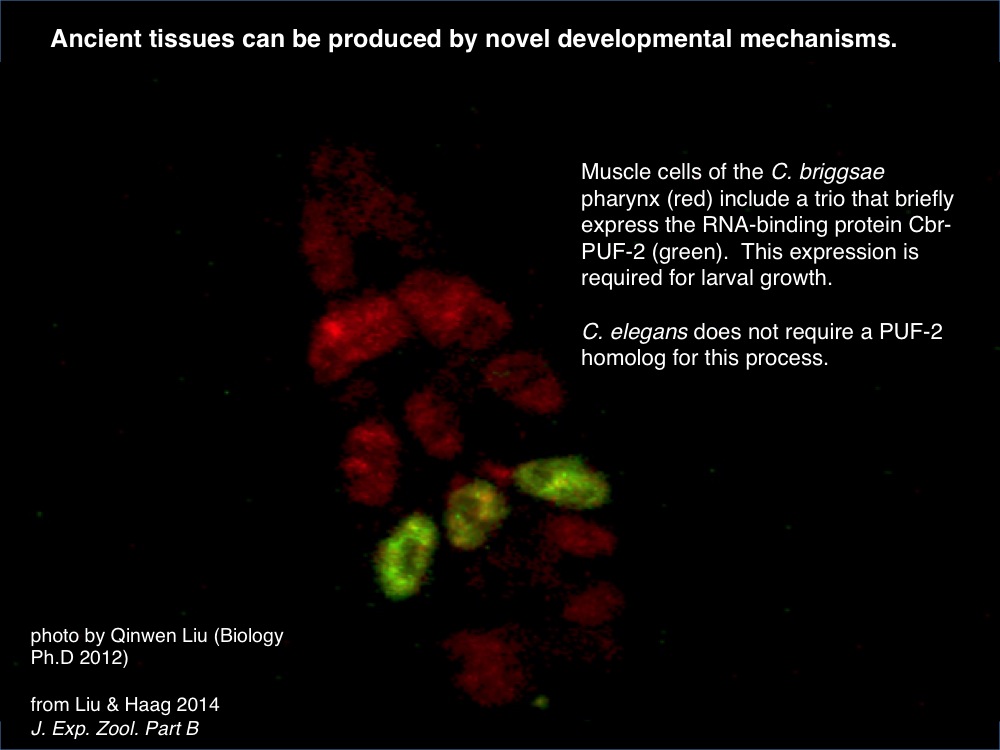
Liu, Q. and Haag, E.S. (2014). Evolutionarily dynamic roles of a PUF RNA-binding protein in the somatic development of Caenorhabditis briggsae. Journal of Experimental Zoology, Part B 322:129-141 PDF
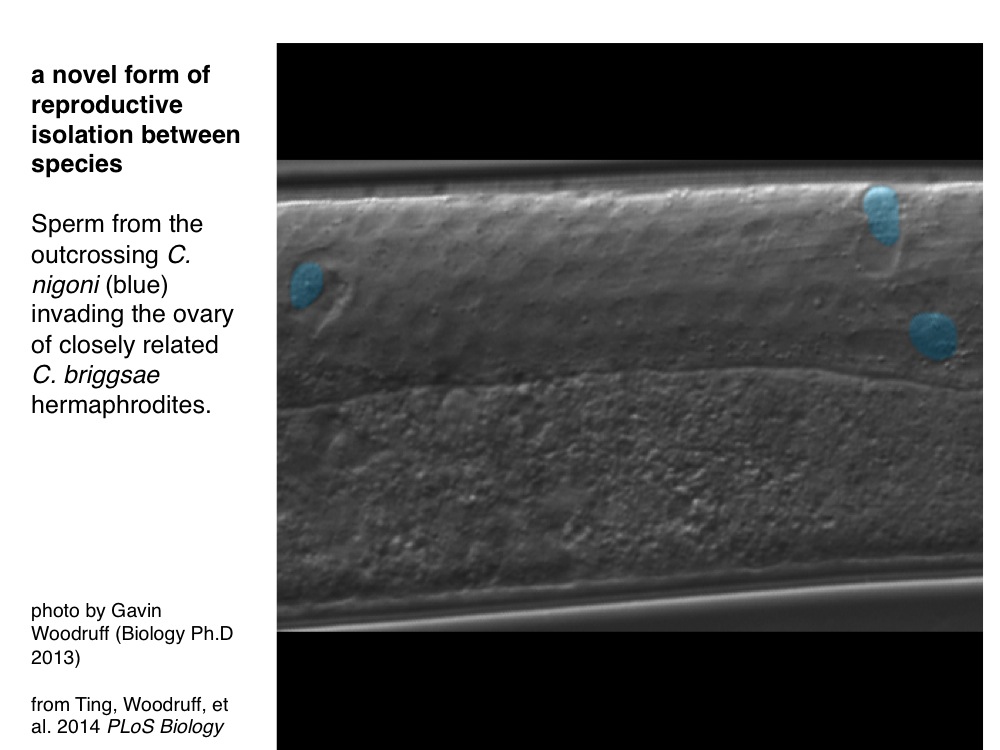
Ting, J.J., Woodruff, G.C., Leung, G., Shin, N-R, Cutter, A.D., and Haag, E.S. (2014). Intense sperm-mediated sexual conflict promotes reproductive isolation in Caenorhabditis nematodes. PLoS Biology 12: e1001915.
Woodruff, G.C., Knauss, C.M., Maugel, T.K., and Haag, E.S. (2014). Mating damages the cuticle of C. elegans hermaphrodites. PLoS ONE 9: e104456.
Beadell, A.V. and Haag, E.S. (2015) Evolutionary Dynamics of GLD-1-mRNA complexes in Caenorhabditis nematodes.
Genome Biology & Evolution 7: 314-335.
Thomas, C.G. and Haag, E.S. (2015) Fundamentals of Comparative Genome Analysis in Caenorhabditis Nematodes. Methods in Molecular Biology 1327: 11-21
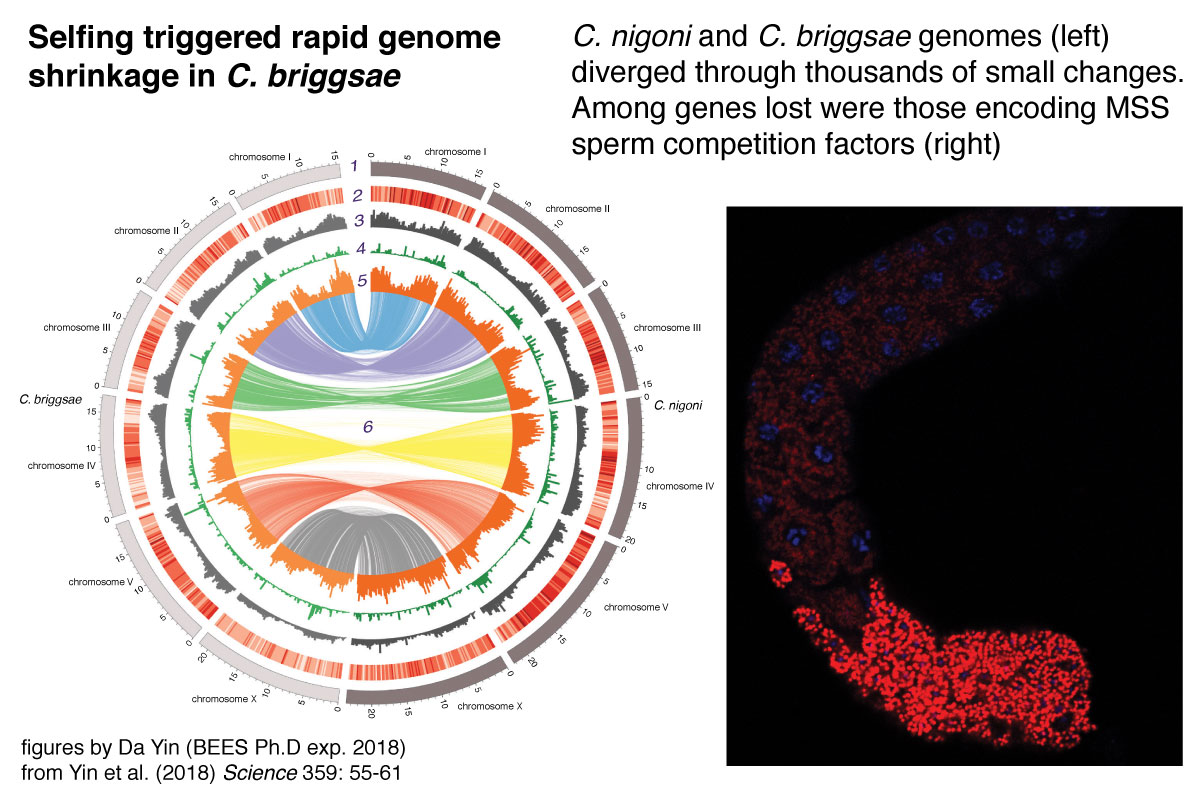
Yin, D., Schwarz, E.M., Thomas, C.G., Felde, R.L. , Korf, I.F., Cutter, A.D., Schartner, C.M., Ralston, E.J., Meyer, B.J., and Haag, E.S. (2018). Rapid genome shrinkage in a self-fertile nematode reveals sperm competition proteins. Science 359: 55-61
Haag, E.S., Fitch, D.H.A., and Delattre, M. (2018) From "the Worm" to "the Worms" and back again: The Evolutionary developmental biology of nematodes. Genetics 210: 397-433
Hu, S, Skelly, L.E., Kaymak, E., Freeberg, L., Lo, T-W., Kuersten, S., Ryder, S.P., and Haag, E.S. (2019) Multi-modal Regulation of C. elegans hermaphrodite spermatogenesis by the GLD-1-FOG-2 complex. Developmental Biology 446: 193-205.
Yin, D. and Haag, E.S. (2019) Evolution of sex ratio through gene loss. Proc. Natl. Acad. Sci. USA 116: 12919–12924.

